
 spacepolicies.org
The 4dimensions© in Space
4dimensions© in Space: A Comprehensive Framework for Strategic Analysis and Web Classification
1. The Problem: Complexity and Fragmentation in the Space Sector
1.1 The complexity challenge of the space domain
The space sector resists clean description. Every entity in it (a satellite, a launch vehicle, a ground station, a piece of legislation, a constellation operator) exists simultaneously as a technological artefact, a regulated object, a managed program, and an instrument of strategic intent. Each description is true; none reduces to the others; and the registers in which they are expressed (engineering, law, management, strategy) do not naturally translate.
The domain stretches across radically different scales at once: physical processes from quantum optics (atomic clocks, optical links) to interplanetary gravity; engineering systems that fold mechanics, software, materials, and human factors into a single platform; industrial supply chains across dozens of jurisdictions; institutional architectures mixing national agencies, international organisations, regulators, and increasingly assertive private actors; a normative environment whose foundational treaties date from the Cold War while its operational fabric is rewritten every quarter.
No single discipline holds this together. To describe any entity adequately, the analyst must move continuously between registers: the language of engineering does not map cleanly onto policy, and neither maps onto finance or strategy.
1.2 The fragmentation of specialist knowledge
The problem is not a lack of expertise. The problem is that expertise is vertical, while the sector is cross-cutting.
Each specialist (scientist, engineer, lawyer, financial analyst, policy maker) sees a different slice of the same entity, and the slices rarely line up. The cost is invisible in isolated tasks and decisive in sector-level decisions: choosing the architecture of a constellation, designing the regulatory envelope for in-orbit servicing, building an agency’s long-term strategy. There, the absence of a shared grammar translates into communication friction, repeated misunderstandings, and decisions that optimise one dimension while quietly degrading another.
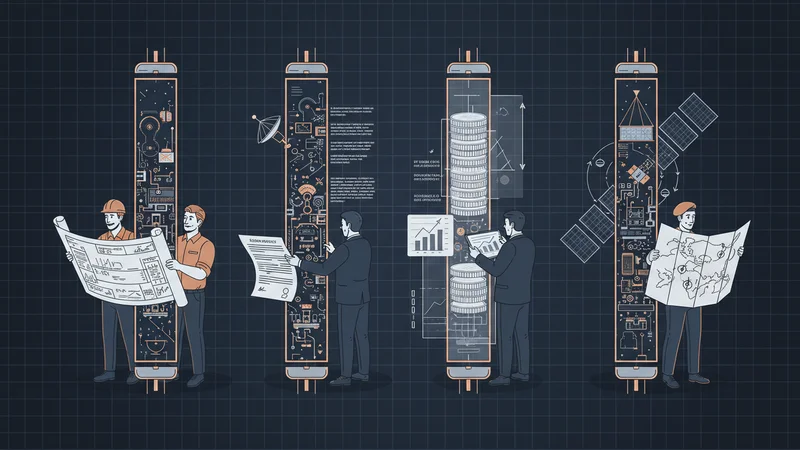
A single satellite exposes the problem in miniature. It is at once a material artefact (alloys, propellants, optics, avionics), a formal object (interface control documents, standards, software protocols), an agentic outcome (designed, built, operated by identifiable organisations), and a teleological device that exists for something: a service, a mission, a strategic objective. Each description is true and necessary; none, alone, is sufficient.
1.3 The need for a unifying grammar
What is needed is not another vertical specialty but a grammar: a set of categories shared across specialties that allows any entity of the sector to be described from multiple analytical angles without losing coherence. A grammar in this sense does not replace expertise; it makes expertise commensurable. The engineer’s account of a launch vehicle, the lawyer’s account of its export-control envelope, and the strategist’s account of its mission can refer to the same object and combine into a unified reading.
Two failure modes are to be avoided: over-abstraction (a framework so general it accommodates everything and clarifies nothing) and borrowed scholasticism (a framework imported wholesale from another domain as if the import had done the analytical work). The framework presented in the following sections draws on two long-established traditions (Aristotle’s four causes and TRIZ’s reading of system levels) without subscribing in full to either, and recombines them into a structure calibrated for the space domain.
1.4 Origin of this work
The framework took shape over a long period of practical work at the Italian Space Agency (ASI), where I was responsible for translating government and Agency leadership directives into plans, reports, and strategies. The same question kept returning: which organising schema would best present the activities under examination? Surveying how other agencies (ESA, NASA, JAXA, CNES, DLR) structure their own strategic documents made the answer harder, not easier: each adopts a schema that responds to its own institutional pressures and to its primary stakeholders. There is no neutral schema.
Beyond political stakeholders (agency leadership, ministries, funding governments), the agency’s own professionals also need to see their activities accurately represented in such documents, and each audience pulls the organising schema in a different direction. The 4dimensions© framework was born from the attempt to build a schema that does not belong to any specific institution and is not optimised for any specific stakeholder group, but offers a shared reading of the sector that any of them can adopt without distortion. Its audience is the broader community of professionals, experts, and researchers working across the boundaries of the space domain.
2. Conceptual Roots
The framework presented in this document draws on two long-standing intellectual traditions that, while developed independently and for entirely different purposes, together provide what the space domain needs: a grammar of why and a grammar of scale. The first comes from Aristotle’s analysis of causes, originally formulated in the Physics and the Metaphysics; the second comes from TRIZ, a twentieth-century theory of inventive problem solving developed by the Soviet engineer Genrich Altshuller.
Neither of the two was conceived with space activities in mind, and neither will be applied here in its original form. What the next pages take from them is the conceptual backbone of the framework: a small number of orthogonal ways of asking why an entity is as it is, and a small number of system levels at which any space entity simultaneously exists. Why these two traditions, rather than systems engineering, enterprise architecture, or general systems theory? Because the pair, taken together, covers exactly the two analytical dimensions a description of a complex sociotechnical entity requires (the dimension of causes and the dimension of scale), and does so in vocabularies abstract enough to remain useful when transposed.
2.1 Aristotle: the four causes as a grammar of “why”
In Aristotle’s Physics (Book II, chapter 3) and again in the Metaphysics (Book V, chapter 2), the question of explaining why something is what it is is answered through four distinct aitiai, usually rendered in English as four “causes”, though the Greek term is closer to “modes of explanation” or “reasons”:
That out of which something comes to be: bronze for a statue, silicon for a chip.
That according to which it is structured: the design of the statue, the architecture of the chip.
That by which it is brought into being: the sculptor who shapes the bronze, the engineer who designs the chip.
That for the sake of which it exists: the purpose the statue serves, the function the chip performs.
The conceptual move that matters here is not the specific list of four. It is the recognition that a complete account of any object requires multiple complementary explanations, none of which reduces to the others. To ask “why does this satellite exist?” admits four legitimate answers (what it is made of, how it is structured, who built it, and what it is for), and any of these four, taken in isolation, is an impoverished account.
The four causes are not, in Aristotle’s own treatment, a closed taxonomy. They function rather as a grammar of interrogation: a finite set of questions that can be addressed to any entity, returning a different but compatible description in each case. This grammatical function (the four causes as four orthogonal angles of attack) is what the present framework adopts. Aristotle’s specific metaphysical commitments (the priority of formal over material, the teleology of nature, the unmoved mover of Metaphysics Λ) are not imported. The four causes are used here as an analytical instrument, calibrated to the entities of the space sector, not as a doctrine to be defended.

2.2 TRIZ: reading a system across its scales
TRIZ (Russian acronym for Teoriya Resheniya Izobretatelskikh Zadatch, “theory of inventive problem solving”) was developed by Genrich Altshuller and his collaborators from the 1940s onwards, originally to extract regularities from large samples of patented inventions. Its centre of gravity is industrial innovation, and most of its apparatus (the 40 inventive principles, the matrix of technical contradictions, the ARIZ algorithm) addresses the question of how to overcome contradictions in the design of artefacts. None of that apparatus is used in the present framework.
What this framework borrows from TRIZ is one specific device: the system operator, often called the “9 Windows”. The system operator instructs the analyst to consider any entity at three simultaneous scales (the subsystem, its components; the system itself, the entity in its integral form; the supersystem, the larger context in which it is embedded) and at three simultaneous times: past, present, and future. The result is a 3×3 grid of viewpoints that prevents the analyst from collapsing the description into any single scale or moment.
The insight worth keeping is simple: the same object yields irreducibly different descriptions depending on the scale at which it is observed.
A satellite described as an integrated platform is one thing; the same satellite described as a node in a multi-platform constellation is something else; the same satellite again, described as a collection of structural, propulsive, electronic and software subsystems, is something different still. All three descriptions are correct; none is a substitute for the others. The present framework adopts this insight, retains the three spatial levels of TRIZ (subsystem, system, supersystem) with a narrowing of the Supersystem’s content (argued in §4.1), and adds a fourth, categorically distinct level (the Foundational, introduced in §4.2) that TRIZ does not have. The temporal axis of the 9 Windows is set aside: it would multiply the framework’s complexity without adding analytical traction for the kinds of static, structural descriptions the sector most often needs.
3. First Axis: The Four Dimensions
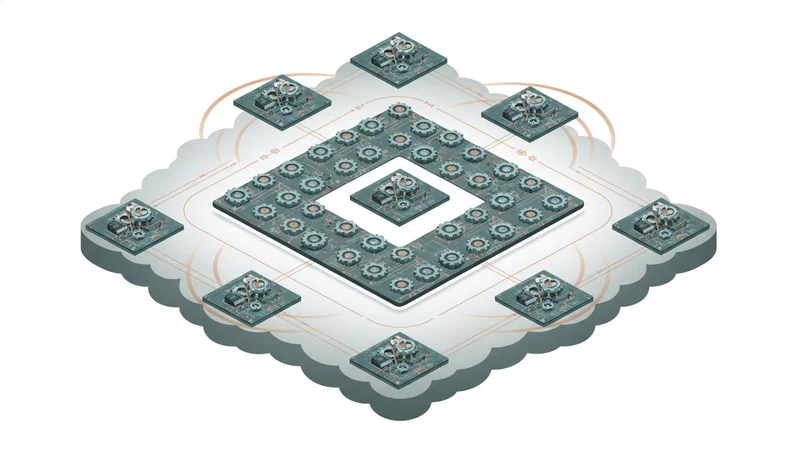
This section presents the first of the two analytical axes of the framework: the four causal dimensions. Each of Aristotle’s four causes is here redeclined to fit the entities and the vocabulary of the space sector. The translation is neither literal nor decorative: each cause is calibrated to capture a specific class of facts about a space entity, with explicit conventions about what falls inside the class and what does not. The system levels (the second axis) are deliberately set aside for now; they enter the picture only in §4. The aim of the present section is to establish, in isolation, what it means to look at a space entity along each of the four causal dimensions.
The space-domain tag attached to each cause was developed during the construction of the spacestrategies.org content taxonomy. The four tags (Technologies, Frameworks, Stakeholders, Purposes) are short, operational labels that travel well in headings, indexes, and navigation; they evoke the original Aristotelian concepts without binding them to a single philosophical reading.
3.1 Material: Assets / Technologies
The material dimension answers the question: what is this entity made of, and what physical or technological substrate does it embody? It collects everything that has substantial, material presence, from the raw resources that pre-exist any human activity (rare earths, water, propellant feedstocks) up to the engineered platforms that occupy orbit and the multi-platform infrastructures that operate at planetary scale. In the space-domain vocabulary of this framework, the material dimension corresponds to Technologies, the term under which the sector routinely classifies its material assets.
Three boundary conventions are essential to keep this dimension clean.
- Tools and facilities (clean rooms, AIT benches, EGSE and MGSE equipment, ground processing centres) are artefacts that participate in this dimension as composites of matter and form (in the Aristotelian sense, synola), not as agents. They belong to Material (and, partly, to Formal), never to Efficient.
- Software in all its forms (code, data models, configurations, cybersecurity rules) is not Material: it has no substantial presence and belongs to Formal, as will be argued in 3.2.
- Raw Natural resources, both terrestrial (rare earths, structural metals, propellant feedstocks) and extraterrestrial (ISRU candidates such as lunar water, Martian regolith, asteroidal volatiles), are part of the material dimension at its most foundational layer: the sector does not produce them, it receives them.
This will matter in §4 and §5, where the boundary between raw and processed materials becomes load-bearing.
3.2 Formal: Architecture / Frameworks
The formal dimension answers the question: what governing principles, structures, and codes give this entity its order? It collects the patterns according to which space entities are organised, regulated, designed, operated, and made interoperable. In the vocabulary of this framework, the formal dimension corresponds to Frameworks: a deliberately broad term that covers everything from interface control documents at the component level, through engineering standards and mission architectures at the platform level, up to international treaties and national space policies at the supersystem level.
Two conventions are worth making explicit from the start.
- Software is form, not matter. Code, data models, configuration files, and cybersecurity frameworks all belong to the Formal dimension: they prescribe how something operates; they do not constitute what it is made of. The convention does real work, letting the framework treat a satellite’s flight software, its avionics ICDs, and the ground segment’s operational procedures as members of the same analytical class.
- The formal dimension is not confined to documented form. It includes implemented procedures, embedded protocols, and operational doctrines, anything that imposes a recognisable order on the sector’s activity, whether or not the order is written down.
3.3 Efficient: Operators / Stakeholders
The efficient dimension answers the question: who acts here, who decides, designs, authorises, builds, operates, regulates, and accepts? It collects all and only the human agents (and their aggregations: teams, organisations, agencies, governments, communities) that exercise agency in the space sector. In the vocabulary of this framework, the efficient dimension corresponds to Stakeholders.
The defining convention of this dimension is strict and worth emphasising: only human agents or their aggregations qualify as Efficient. No artefact, however sophisticated, autonomous, or intelligent, counts as an efficient cause in this framework. An autonomous spacecraft executing a manoeuvre is performing an operation, but the agency that decided the manoeuvre, that programmed the logic, that owns the platform, and that bears the responsibility for the outcome is human. This convention prevents a common confusion in contemporary discussions of the space sector, where the increasing capability of automated systems can blur the boundary between tools and agents. In the 4dimensions© framework, the boundary is held firm: artefacts go in Material and Formal; (human) agents go in Efficient.
The aggregation levels matter. Agency operates at every scale: a single engineer, a project team, a private company, a national agency, an international organisation, a treaty community. Each is an agent at its own scale. This stratification of agency aligns naturally with the system levels of §4, but the present section deliberately leaves that alignment for later.
3.4 Final: Mission / Purposes
The final dimension answers the question: toward what is this entity oriented, what does it exist for? It collects the ends, objectives, and purposes that the space sector either takes as given (pre-strategic commons) or sets for itself (operational objectives, strategic missions, civilisational ambitions). In the vocabulary of this framework, the final dimension corresponds to Purposes.
The Final dimension has the widest internal range of the four. At its most foundational, it includes the pre-strategic commons that any space activity must respect for its legitimacy: the peaceful use of outer space, the sustainable use of orbital and spectral resources, equitable access to the benefits of space, the long-term safety of the orbital environment. These are not objectives chosen by the sector; they are conditions on the sector’s choices. Above this foundational layer, the Final dimension scales up through operational performance objectives (reliability, data integrity, modular upgrade pathways), through system-level service capabilities (communications, observation, navigation), up to supersystem-scale civilisational objectives (international cooperation, planetary defence, the long-term extension of human presence beyond Earth).
The breadth of this dimension is its main risk. Without a discipline that separates non-negotiable conditions from chosen objectives, the Final dimension collapses into a wish-list. §4 reintroduces this distinction by isolating, at the Foundational level, the pre-strategic commons; §5 codifies it as the Final-Foundational convention. A complementary status distinction, introduced in §5.4, marks the Subsystem cell of this dimension as derivative: at that level the Final dimension holds the performance requirements into which system-level purposes descend, not independent ends.
4. Second Axis: The Four System Levels
This section presents the second of the two analytical axes of the framework: the levels of system at which any space entity simultaneously exists. The first three levels (Subsystem, System, Supersystem) are inherited, with adjustments, from one axis of TRIZ’s system operator introduced in §2.2. The fourth level, called here Foundational, is the most consequential conceptual move of this framework: it has no direct correspondent in TRIZ, and (together with the four causal dimensions) gives the framework its specific analytical reach. Most of the present section is devoted to motivating and clarifying it.
4.1 The TRIZ-derived levels: Subsystem, System, Supersystem
The three classic spatial levels of the TRIZ system operator are adopted here as nested scales of integration: a single entity, examined at any moment, can be described at three such scales. The upper level (the Supersystem) is narrower in this framework than in classical TRIZ; the note placed after the third definition makes the adjustment explicit.
Collects components and assemblies at the configuration-item / configuration-set granularity. It is the plane at which a space entity is decomposed into its constructed parts: avionic boxes, propellant tanks, scientific payloads, structural elements, software libraries, ground-segment terminals. It is the first level of engineered matter and form.
Collects integrated platforms and operational infrastructures: a complete satellite, a launch vehicle, a ground station, a mission control centre, an AIT facility. At this level the entity is the operational unit taken as a whole: what flies, what launches, what operates.
Collects multi-platform aggregates and their governance: satellite constellations, space stations, interplanetary transport architectures, global tracking systems, but also the markets, the regulatory bodies, the international agreements, and the doctrines within which those aggregates function. At this level the entity is no longer a thing but an ecosystem.
A note on entity types. The descriptions of the three levels above are most naturally illustrated by entities of artefactual nature (satellites, launch vehicles, infrastructures). Entities of organisational nature (e.g. a space agency, an industrial consortium) populate the same three levels with analogous but kind-specific contents: departments and directorates at Subsystem, the integral organisation at System, the institutional ecosystem at Supersystem. Entities of normative nature (e.g. a treaty, a regulation) populate them with articles and provisions at Subsystem, the integral normative instrument at System, the broader regime of which it is part at Supersystem. The methodological question of how to enter the matrix from each entity type is addressed as an open development in §7.2.
A note on the redefinition. The Supersystem as just described is narrower than the Supersystem of classical TRIZ. In TRIZ, the Supersystem absorbs both the operational ecosystem and the physical-environmental context in which the system operates: for a satellite, the cosmic-orbital environment, the radiation environment, the solar weather would all sit at the Supersystem level. The present framework reassigns that physical-environmental content to the Foundational level (§4.2), on the grounds argued there: it is not on the same plane as multi-platform aggregates, treaties, and markets. It sits on the plane of what is received by the sector. The Supersystem of this framework is therefore the integrated upper scale of the sector’s products, operational and institutional, and nothing else.
These three levels share a single feature that is essential to grasp before introducing the fourth: they all describe what the space sector constructs, or, more precisely, what is subject to its ordinary strategic action. The Subsystem level describes the smallest things the sector builds; the System level describes the integral platforms it builds; the Supersystem level describes the networks and institutions it builds and the regulations it routinely revises. All three are levels of contents the sector acts upon.
4.2 The Foundational level: the plane of operative givens
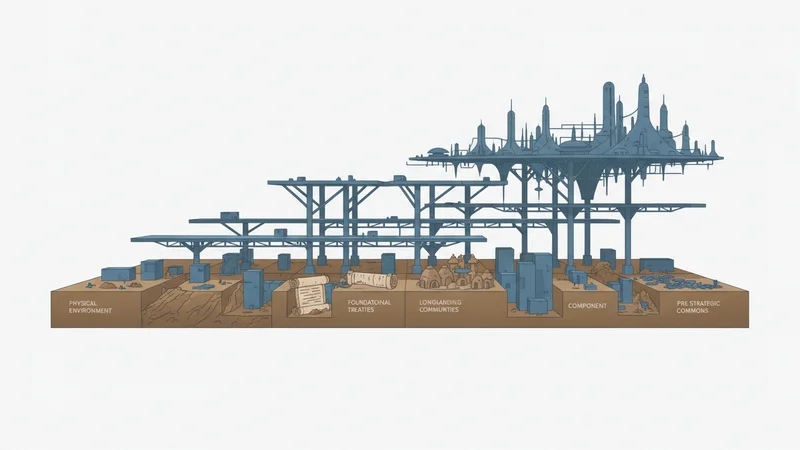
The fourth level, the Foundational, gathers what the space sector takes as given for the purpose of ordinary strategic action. A content belongs to the Foundational if no actor in the sector can revise it through ordinary strategic action, whether because it is ontologically received (physical reality, the laws of nature, the cosmic-orbital environment) or because it is historically constituted but operatively given (foundational space-law treaties, longstanding epistemic communities, pre-strategic commons). The two sources differ in origin but converge in function: the entity being analysed receives the content as a constraint, not as a decision variable.
Concretely, the Foundational level is the plane of:
The setting in which space activity takes place: the cosmic-orbital environment, gravitational fields, the electromagnetic spectrum as a physical medium, vacuum and thermal conditions, ionising radiation, solar and space weather, upper-atmospheric properties.
That constrain any space activity: physical and astrodynamic laws and their formalised representations (drag and propagation models, re-entry models), together with the foundational space-law treaties, in particular the Outer Space Treaty 1967 and its core extensions.
That make space activity possible at all: epistemic communities (scientific, engineering, legal), basic research institutions and academies, standards bodies, training networks, and the communities of practice these institutions sustain.
That condition the legitimacy of any space activity: peaceful use of outer space, sustainable use of orbital and spectral resources, equitable access, long-term space safety, advancement of fundamental knowledge as a commons.
Read across the four causal dimensions, the Foundational answers four pre-strategic questions: what there is (Material), how it works (Formal), who has standing (Efficient), and why ultimately (Final). These are not asked by the sector in the same sense as the analogous questions at higher levels: the Material question at System level is “what is this satellite made of?”, which the sector answers with its own choices; the Material question at Foundational level is “what is there to work with?”, whose answer the sector receives.
📜 An Aristotelian footnote (for the philologically curious)
In Aristotle’s Metaphysics (Book Λ), the analysis of causes converges on the problem of the primum movens: an explanation of motion or change must terminate in something that is not itself moved or caused, otherwise the regress is indefinite. The Foundational level in this framework plays a functionally analogous role, without any metaphysical commitment. It gathers what is given to the space sector (its physical environment, the laws that constrain it, the communities that sustain it, the commons that legitimise it), and distinguishes these from what the sector produces across the higher levels.
This is not a philological reconstruction of Aristotle. The four causes were never a closed taxonomy; they functioned as a grammar for asking why things are as they are. Adding a “plane of the received” as the starting node of that grammar is an extension consistent with its spirit, and one that the space domain, with its sharp distinction between conditions and products of human activity, makes especially natural.
5. The 4×4 Matrix: the Device
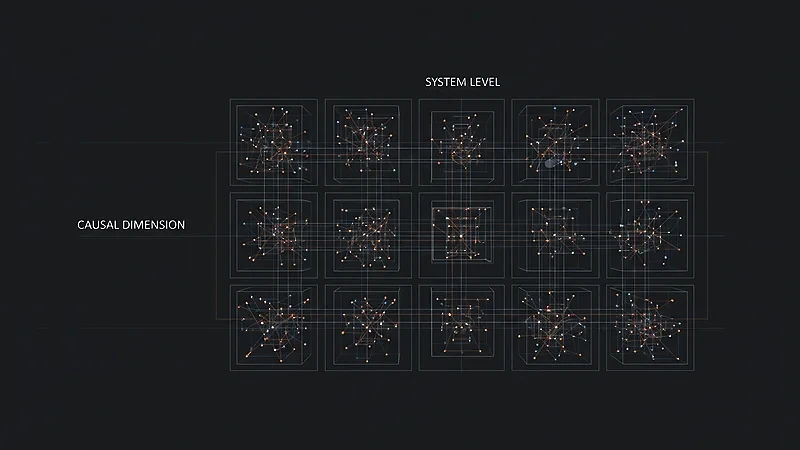
The previous two sections introduced the two analytical axes of the framework independently of each other. This section brings them together. The four causal dimensions (Material, Formal, Efficient, Final) are crossed with the four system levels (Foundational, Subsystem, System, Supersystem) to yield a 4×4 grid of sixteen cells, each of which collects a specific class of content that a complete description of any space entity should populate. The grid is the operative device of the framework: it makes the abstract grammar of §3 and the level architecture of §4 usable in concrete analytical work.
5.1 The crossing: sixteen coherent categories
Each of the sixteen cells is identified by a (dimension, level) pair. The pair Material × Foundational collects raw material substrates and the physical operating environment; the pair Formal × Supersystem collects market mechanisms, national policies, ordinarily-revisable international agreements; the pair Efficient × Subsystem collects engineers and manufacturing specialists; and so on for the remaining thirteen pairs. The full content of each cell is given by the matrix in §5.5.
Two structural properties of the grid are worth stating explicitly. Cells are internally homogeneous: each collects content of one specific dimensional kind (Material, Formal, Efficient, or Final) at one specific level of integration (Foundational, Subsystem, System, or Supersystem). Cells are not exclusive at the entity level: a real space entity typically populates several at once. A satellite, for example, populates Material × System (as an integrated platform), Formal × System (as a mission architecture), Efficient × System (through its operating organisation), and Final × System (through its operational objective), while at the same time drawing conditions from the Foundational row and embedding in the Supersystem row.
The grid is therefore a description-organising device, not a classification device: instead of asking “where does this entity belong?”, it asks “what does this entity contain at each of the sixteen kinds of place?”.
The subsections that follow codify the conventions needed to keep the grid coherent in practice: the Material boundary between Foundational and Subsystem (5.2), the Final-Foundational as the locus of pre-strategic commons (5.3), and the level doctrine of each dimension (5.4), which states, for each dimension, the criterion by which its four cells are populated.
5.2 The Material boundary: the first industrial transformation
A specific convention is needed to draw the line between Material × Foundational and Material × Subsystem, the boundary at which “what the sector receives” hands over to “what the sector engineers”. The convention is the following: the boundary between Foundational and Subsystem on the Material dimension is the first industrial transformation of a material substrate.
On the Foundational side of the line sit raw geological and chemical resources as they are received from the natural world: terrestrial rare earths, structural and refractory metals in their natural ore, propellant feedstocks (raw hydrocarbons, raw oxidisers); together with the natural extraterrestrial resources that count as ISRU candidates: lunar water and lunar regolith, Martian water and surface materials, asteroidal volatiles and metals. On the Subsystem side sit the products of first industrial transformation: refined alloys (titanium alloys, aluminium-lithium, carbon-carbon composites), formulated propellants (RP-1, hydrazines, LOX/LH2, formulated solid grains), engineered ceramics, electronic-grade silicon, processed photovoltaic cells.
The convention has a non-obvious consequence worth highlighting. Extraterrestrial resources are Foundational, not Subsystem, until they are industrially transformed. Lunar water as a natural resource lies in the same Material × Foundational cell as terrestrial rare earths, even though it is geographically “above” Earth, because the operative criterion is industrial state, not geographical altitude. Once transformed (lunar water electrolysed and stored as cryogenic propellant on an orbital refuelling depot, for example), the resulting product moves to the Subsystem level.
5.3 The Final-Foundational: pre-strategic commons
A second specific convention is needed for the Final × Foundational cell. As anticipated in §3.4, the Final dimension has the widest internal range of the four: it spans from non-negotiable conditions on the legitimacy of activity to civilisational ambitions chosen by the sector. The convention that organises this dimension at the Foundational level is the following: the Final × Foundational cell gathers pre-strategic commons, ends that condition the legitimacy of any space activity rather than being chosen by the sector itself.
Four such commons populate this cell. The peaceful use of outer space as enshrined in the foundational treaties (notably OST 1967, Article IV, and the broader doctrine of space as a province of all mankind). The sustainable use of orbital and spectral resources, including the long-term preservation of the orbital environment against debris growth and the conservation of usable spectrum as a finite commons. Equitable access to the benefits of space, which sits at the foundation of the OST framework and recurs in successive declarations. The long-term safety of the orbital environment as a precondition of any future activity. To these four can be added a fifth, more often implicit than codified: the advancement of fundamental knowledge as a commons shared across the international scientific community.
One clarification keeps this cell from being misread. The convention places the principles at Final × Foundational; it does not place at this cell the operational interpretations of those principles. Whether a specific dual-use payload counts as “peaceful” under OST Article IV, or how a specific debris-mitigation guideline should be implemented in a constellation’s end-of-life plan, are questions answered at Supersystem-Formal (policy and diplomacy) and at System-Formal (mission architecture), not at Final × Foundational. The Foundational layer holds the non-negotiable principle; the levels above hold the ordinarily-revisable instruments through which the principle is given operational content.
5.4 The level doctrine of each dimension
The uniform 4×4 geometry is a deliberate architectural choice. A single set of four levels shared by all four dimensions is what makes the cells commensurable across dimensions, which in turn is what makes cross-dimensional emergent properties (§6.4) readable and the grid usable as an auditable contract for shared analytical work (§6.6). Uniformity, however, is earned rather than assumed: each dimension populates the same four cells according to its own logic, and where that logic is not obvious it is stated here as the level doctrine of the dimension. A level doctrine does two things: it names the criterion by which content is assigned to the four cells of that dimension, and it marks the status of cells whose content is thin or derivative. The four doctrines below address the boundary questions that earlier drafts of this framework kept open (recorded in §7.2).
Material. The Material doctrine is part-whole scale, with the Foundational boundary fixed by the first industrial transformation (§5.2). The four cells are ordered: received substrates, engineered components, integrated platforms, multi-platform aggregates. One further convention completes the doctrine: a platform belongs to the System cell as soon as it is an integrated operational unit — what flies, what launches, what operates; it moves to the Supersystem cell only when it is analysed as an aggregate of platforms — an orbital station read as an inhabited multi-module complex, an observatory read as a node of a distributed observing network. The distinction is analytic, not physical: the same artefact may legitimately populate both cells in different readings.
Formal. The Formal dimension holds two species with different scale logics, and the doctrine assigns each its own rule. Engineered form (specifications, ICDs, architectures, procedures) scales by part-whole, mirroring the Material doctrine. Normative form (treaties, regulations, allocations) does not scale by part-whole; it scales by revisability, applying the criterion of §4.2: content that no actor in the sector can revise through ordinary strategic action sits at Foundational; content the sector ordinarily revises sits at Supersystem; mission-level normative content (architectures, governance frameworks) sits at System; component-level normative content (specifications, procedures) sits at Subsystem. Applied to the boundary questions of §7.2, the test places the foundational space-law treaties and their core extensions — the Outer Space Treaty 1967 together with the Liability, Registration and Rescue conventions — at Formal × Foundational, as instruments the sector receives rather than revises; it also places at that cell the cross-sectoral foundational regulations that reach the space sector as operative givens inherited from adjacent domains (foundational safety, export-control and non-proliferation regimes), while the instruments those regimes routinely revise remain at Supersystem.
Efficient. The Efficient doctrine is scale of agency: the four cells are ordered by the reach of the acting organisation, from component-level practitioners to ecosystem-level institutions. Two conventions keep the doctrine clean. First, the Foundational cell is a cell of standing, not of scale: it collects the communities that sustain the sector’s capacity to act (epistemic communities, research institutions, standards bodies, training networks), without regard to their organisational size. Second, individual historical figures do not populate any cell: the criterion that would place them is historical influence, an axis the grid excludes. They are carried by the temporal overlay of §7.2, applied to the Efficient column when an analysis needs to account for the actors who shaped the sector’s trajectory. Finally, organisations that perform two functions at once (standards-setting and regulatory) are assigned by the function being exercised in the analysis at hand, not by identity: the same body may sit in the Foundational cell in one reading and in the Supersystem cell in another.
Final. The Final doctrine is a ladder of ends rather than a scale of parts, and its four cells carry explicit statuses. Final × Foundational holds conditions, not objectives: the pre-strategic commons of §5.3. Final × Subsystem holds derivative objectives: the performance requirements into which system-level purposes are translated when they descend into components — the terminus of the requirements cascade, populated by specification flow rather than by independent ends. Final × System holds the sector’s chosen operational objectives: the service capabilities and mission purposes an entity sets for itself. Final × Supersystem holds civilisational ambitions: the ends that exceed any single actor. The Subsystem cell is thin by design, and its thinness is informative: a component with no content there has no declared purpose-constraint, and that emptiness is part of the description.
The doctrine structure is the framework’s answer to the tension between tractability and precision. The number of levels is a global parameter of the device, and it remains fixed at four for every dimension; the differentiation between dimensions lives in these conventions, which are local, explicit, and revisable at the first counter-evidence from analytical practice.
5.5 The complete matrix
The crossing of the four causal dimensions with the four system levels yields the following sixteen-cell matrix. Each cell collects the content described in §3 and §4 at the corresponding (dimension, level) pair, with the conventions of 5.2-5.4 applied.
| ↓Dimension\Level→ | Foundational | Subsystem | System | Supersystem |
|---|---|---|---|---|
| Material: Assets/Technologies |
What there is: Operating environment and material substrates The pre-existing physical environment resources. Cosmic-orbital environment: • Electromagnetic, gravitational, and geomagnetic environment • Radiation, space weather, and upper-atmosphere conditions • Debris/micrometeoroids, vacuum, thermal, and microgravity conditions Raw material substrates: • Foundational geological resources • Water and ice resources • Foundational energy substrates |
Engineered components: • Engineered materials, alloys and composites • Refined propellants and fuels • Equipment and scientific instruments • Propulsion modules and power systems • Tooling and facilities (EGSE/MGSE, AIT benches, clean rooms) |
Integrated platforms: • Satellites, probes and spacecraft • Launch vehicles and spaceports • Ground stations and mission control centres • Communication networks • Data processing facilities • AIT facilities and integration infrastructure |
Multi-platform networks: • Space stations and observatories (when read as multi-platform aggregates; see §5.4) • Satellite mega-constellations • Interplanetary transport systems • Planetary bases and colonies • Global tracking systems |
| Formal: Architecture/Frameworks |
How it works: Foundational laws and base norms The fundamental laws (descriptive) and base norms (prescriptive). • Physical laws and mathematical constants • Fundamental orbital mechanics and astrodynamics • Atmospheric drag and re-entry models (formalised representations of physical constraints) • Foundational space law (Outer Space Treaty 1967 and its core extensions: the Liability, Registration and Rescue conventions) • Basic safety principles (peaceful use, non-appropriation, liability) • Cross-sectoral foundational regulations (operative givens inherited from adjacent domains) |
Component specifications: • Engineering specifications • Interface control documents • Technical standards and protocols • Quality assurance standards • Testing and qualification procedures • Software libraries, data models and cybersecurity frameworks • Tooling/EGSE/MGSE procedures, configurations and scripts |
Platform design patterns: • Mission architectures • Systems engineering processes • Project governance frameworks • Safety cases and risk management • Facility operational procedures |
Domain coordination: • International space agreements (ordinarily revisable) • National space policies • Global standards and interoperability protocols • ITU frequency allocations and Radio Regulations • Strategic doctrines and diplomatic frameworks • Market mechanisms and governance • Business models and organisational structures |
| Efficient: Operators/Stakeholders |
Who has standing: Foundational communities The pre-existing and base actors. • Epistemic and professional communities (scientific, engineering, legal) • Basic research institutions and academies • Standards organisations (ISO, CCSDS, ECSS, IEEE) • Educational foundations and training networks |
Component creators: • Managers, engineers and scientists • Manufacturing specialists • Software developers and testing engineers • Quality assurance specialists • Supply chain managers |
System integrators: • Space agencies and applied research institutions • Private space companies • Satellite operators and launch providers • Mission control teams • Ground segment operators |
Ecosystem coordinators: • Governments and legislative bodies • International space organisations • Regulatory authorities (national space agencies in their regulatory function, FCC, FAA-AST, etc.) • Global scientific community • Industry consortiums • Policy makers and strategic planners • Insurance underwriters • Certification bodies |
| Final: Mission/Purposes |
Why ultimately: Foundational commons The ends that the sector takes as given. • Peaceful use of outer space as the province of all mankind • Sustainable use of orbital and spectral resources • Equitable access to space benefits • Preservation of long-term space safety (orbital sustainability, debris mitigation as principle) • Advancement of fundamental knowledge as commons |
Functional performance (derivative objectives): • Ensuring reliable component operation • Maintaining safety and quality standards • Achieving data integrity and availability • Providing environmental compliance • Enabling modular upgrade pathways |
Operational capabilities: • Conducting space-based research • Providing Earth observation services • Enabling global communications • Supporting navigation and positioning • Generating commercial value |
Civilisational objectives: • Advancing human presence in space • Fostering international cooperation • Addressing global challenges • Supporting planetary defence • Driving human evolution beyond Earth • Sustainability targets • Evolution pathways |
This matrix, which is illustrative and not exhaustive, is intended as a reference tool.
In analytical practice, a spatial entity may occupy the sixteen cells with varying densities: most entities cluster in a subset of the grid, and the empty cells are themselves analytically informative, signalling aspects that are either inherited unchanged from a broader context or simply not part of the entity’s content. §6 develops the methodology that uses this matrix to read a concrete entity.
6. How It Is Used: A Methodology for Holistic Analysis
Having built the device in §5, this section turns to its use. The 4dimensions© framework is applied to any space entity through a structured three-step sequence, followed by validation. The methodology is designed for the holistic examination of an entity: it produces, at the end, a unified strategic reading, not a checklist of dimensional and level-specific findings.
6.1 Primary analytical question and operative sequence
The methodology is organised around a single guiding question:
Across the four causal dimensions and the four system levels, what does this entity contain, what does it receive from its conditions of possibility, and how do the resulting sixteen kinds of place interact to yield its strategic implications?
The question is answered in three successive steps: investigation along the four dimensions (§6.2), mapping along the four levels (§6.3), and integration of the resulting sixteen-cell description into a unified understanding (§6.4). Validation criteria (§6.5) and a note on the use of the framework in human-AI collaboration (§6.6) close the methodological discussion. §6.7 sketches four representative entity types and their natural entry points into the matrix; fully worked examples are deferred to a subsequent treatment (§7.2).
6.2 Step 1: Investigation along the four dimensions
The first step interrogates the entity through the four guiding questions of §§3.1-3.4. For any entity of interest, the analyst formulates an answer to each of the four questions, deliberately treating them as complementary descriptions of the same object:
- Material → Technologies: What is this entity made of, and what physical or technological substrates does it embody?
- Formal → Frameworks: What governing principles, structures, codes, protocols, and architectures give this entity its order?
- Efficient → Stakeholders: Who acts here, who decides, designs, authorises, builds, operates, regulates, and accepts?
- Final → Purposes: Toward what is this entity oriented, what does it exist for?
The discipline of this step is to keep the four answers separate. A common failure mode is to fold them prematurely into a single integrated description that privileges one dimension, typically the Material one (because it is the most visible) or the Final one (because it is the most rhetorically attractive). The four answers must be produced independently before they can be productively integrated in Step 3.
6.3 Step 2: Multi-level mapping
The second step takes each of the four answers produced in Step 1 and distributes its content across the four system levels of §4: Foundational, Subsystem, System, Supersystem. The result is, for each dimension, an articulation of the entity along the scale of integration:
- Foundational: at what conditions does the entity rest? Which operative givens (physical environment, foundational law, longstanding communities, pre-strategic commons) does it presuppose along this dimension?
- Subsystem: which component-level contents along this dimension belong to the entity’s interior?
- System: which platform-level contents along this dimension constitute the entity in its integral form?
- Supersystem: which ecosystem-level contents along this dimension contextualise the entity?
When this step is carried out for all four dimensions, the entity is described in the sixteen-cell format of the matrix. Most entities will not populate every cell with content of their own: many cells are inherited unchanged from a broader context, and the empty cells themselves are part of the description (they record what the entity does not control, contribute, or determine).
6.4 Step 3: Integration assessment
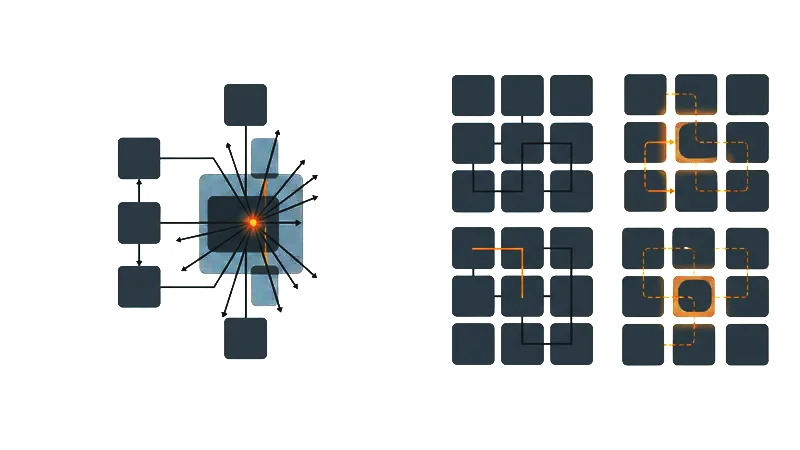
The third step is the analytical core of the methodology. With sixteen cells of description in hand, the analyst now looks for the relations between cells: where does the content of one cell condition the content of another? Where does the interaction of multiple cells produce something that is not visible in any single cell alone?
Three classes of relation are particularly informative.
A property is emergent when it requires the simultaneous alignment of two or more dimensions to exist. Mission Assurance, for instance, is not located in any single cell: it is the joint product of Material reliability (component grade), Formal discipline (verification procedures and ICDs), Efficient capability (team competence and accountability), and Final clarity (clearly defined success criteria). Disturbing any one of these dimensions degrades the property. Similar emergent properties (operational resilience, regulatory legitimacy, strategic autonomy) are produced through the conjunction of specific dimensional cells and cannot be read off any of them in isolation.
A dependency is cross-level when content at one level enables, constrains, or threatens content at another. The Foundational debris environment (Material × Foundational) conditions the System-level shielding design (Material × System), which in turn conditions the Supersystem-level deorbit obligations (Formal × Supersystem), which in turn shape the Final-level operational expectations (Final × System). Tracing such chains exposes both the entity’s resilience and its hidden vulnerabilities: a chain that crosses from a Foundational layer the entity does not control to a System-level feature it does control is a structural exposure to change in the Foundational.
For many space entities a distinction can be drawn between a routine operational mode, in which only the higher-level cells are dynamic while the Foundational cells are taken as fixed, and an adaptive mode, in which a change in a Foundational cell (a new norm, a degraded environment, the activation of a new community) forces a re-assessment across the entire grid. Identifying which mode the entity is currently in, and which mode it would have to move to under plausible scenarios (rise of ISRU resources, soft-law evolution on rendezvous-and-proximity operations, emergence of cislunar governance, etc.), is one of the most strategically informative outputs of the analysis.
The end product of Step 3 is a synthesis: a unified strategic reading of the entity in which the sixteen cells, the emergent properties, the cross-level dependencies, and the prevailing mode of operation are held together as a single description.
6.5 Validation criteria and the return to holistic unity
The segmentation into dimensions and levels brings analytical rigour, but it also introduces a risk of fragmentation: a sixteen-cell description that never reassembles into a unified reading is a catalogue, not an analysis. The validation step asks whether the analysis has actually returned the entity to a coherent whole, and not merely catalogued its parts.
A well-executed analysis satisfies the following criteria:
- All four dimensions have been examined independently before being integrated.
- The entity has been mapped across all four system levels, with explicit note of which levels are inherited and which are populated by the entity’s own content.
- At least one cross-dimensional emergent property has been identified and characterised.
- At least one cross-level dependency chain has been traced.
- The strategic implications of the entity are stated as a unified reading, not as a list of dimensional or level-specific findings.
- The empty cells of the matrix are addressed: their emptiness is justified, not ignored.
The last point matters more than it may seem. An entity that is silent on a specific cell (a satellite operator with no articulated Final × Supersystem reading, for instance, or an agency with no Efficient × Foundational engagement with its sustaining communities) is communicating something about its strategic posture; a methodology that lets the silence pass without comment fails to capture an essential feature.
6.6 The framework as scaffold for human-AI analytical work
The 4×4 matrix functions as a structured contract for analytical work distributed between human experts and AI systems. Three properties of the grid make it particularly well-suited to this role.
Explicit slots reduce the verification cost. A free-form analytical brief returned by an AI system is hard to audit: claims are scattered, dependencies implicit, omissions invisible. A draft organised by the sixteen cells exposes each claim at a known location and allows cell-by-cell critique rather than holistic acceptance or rejection.
Empty cells are diagnostic. When an AI-generated description leaves a cell blank, the emptiness is itself informative: either the entity legitimately has no content there (a fact the analyst confirms), or the model has missed an aspect (a fact the analyst supplies). Free prose loses this signal.
The grid parallelises naturally. The matrix decomposes into per-cell sub-tasks for agentic execution, with the integration step (§6.4) reserved to the human analyst, where strategic judgement resides. Coverage and speed move to the machines; integration and accountability remain human.
The framework’s discipline does not make AI more accurate; it makes the collaboration auditable, which is the property a working analyst actually needs.
6.7 Entity types and natural entry into the matrix
A fully developed worked example would close the methodological circle of this section. Developing one in full would, however, unduly lengthen the present document, and is deferred to a subsequent treatment. What the present subsection delivers in its place is a schematic: four representative space entities are identified, and for each the natural entry point into the matrix is indicated, the home cell (or home cells) from which the three-step methodology begins, before articulating outward into the remaining cells of the grid.
(a Galileo IOV satellite, an IRIS² platform once specified.) Natural entry: Material × System, since the entity is primarily a physical platform. From there the analysis traces downward (Material × Subsystem: avionics, propellant, payloads; Material × Foundational: orbital mechanics, debris environment, spectrum), upward (Material × Supersystem: the constellation context), and crosswise to populate the remaining three dimensions at the System level (Formal: mission architecture; Efficient: operator, integrator, agency principal; Final: service objective).
(the Centre Spatial Guyanais in Kourou.) Natural entry: Material × System combined with Efficient × System, since the entity is at once a physical infrastructure and an operating organisation. The analysis must hold the two home cells together from the outset, then articulate outward through Formal × Supersystem (the IGA, the ESA framework, the host-state agreements) and through Final × Supersystem (the spaceport’s role in European strategic autonomy and in the global launch market).
(ASI, CNES, ESA, NASA, JAXA.) Natural entry: Efficient × Supersystem for agencies of international or national reach, Efficient × System for smaller national agencies. From the home anchor the analysis traces what the agency builds (Material), what it regulates and codifies (Formal), and what it pursues (Final), typically distributing content across the System and Supersystem layers, with Foundational dependencies on the agency’s sustaining communities and on the foundational normative regime within which it operates.
(the Outer Space Treaty 1967, sitting at Formal × Foundational; or the ITU Radio Regulations, sitting at Formal × Supersystem.) Natural entry: Formal × [its level]. The analysis here inverts the usual perspective: the entity is itself a Formal-layer content, and the methodology traces the entity’s effects across the rest of the matrix: which Material configurations it constrains, which Efficient actors it binds, which Final commons it sustains or instruments.
7. Conclusion and Developments
7.1 Synthesis of the contribution
The 4dimensions© framework developed across §§1-6 can be summarised by two structural moves.
An analytical grammar on two axes. A vertical axis of why: the four reinterpreted Aristotelian causes (Material, Formal, Efficient, Final), operationalised in the space domain as the tags Technologies, Frameworks, Stakeholders, Purposes. A horizontal axis of scale: the four system levels (Foundational, Subsystem, System, Supersystem), adapted from TRIZ but redefined relative to it. The crossing of the two axes yields the sixteen-cell matrix of §5, the operative device of the framework.
Two distinct uses sharing a common grammar. The framework supports a holistic analytical methodology (§6) for examining individual space entities, comprising the three-step sequence of dimensional investigation, multi-level mapping, and integration assessment; and a web classification system (Appendix A) derived as a one-axis projection of the full matrix, calibrated for content organisation rather than for strategic analysis. The two share a common grammar but differ in granularity and purpose: the first lives on two axes and sixteen cells; the second lives on one axis and four tags.
7.2 Open questions and lines of development
The framework presented here is a preliminary configuration. Several questions remain open and are recorded here as lines of development for subsequent iterations.
The notion of “entity” itself. Throughout this document the term “entity” has been used to designate any object of analysis examined through the matrix: a satellite, a constellation, an agency, a treaty, a mission, a service. This is a deliberately permissive use (the matrix is a description-organising device, not a classification of types), but it conceals a methodological refinement only partially articulated here. Different entity types have different home cells in the matrix: an artefact is naturally read first at Material × [its level]; an organisation at Efficient × [its level]; a normative regime at Formal × [its level]; a mission at Final × [its level]. A first sketch of this typology is given in §6.7. The full development of the home-cell methodology (type-specific rules for entering, traversing, and reassembling the matrix according to each entity’s natural anchor) is deferred to a subsequent treatment.
The temporal dimension. §2.2 set aside the temporal axis of TRIZ’s 9 Windows on the grounds that adding it would multiply the matrix from sixteen to forty-eight cells, beyond what the framework can carry without losing tractability. The decision was an economic one, not a conceptual one. Temporal articulation (heritage, present configuration, future projection) carries strategically important information, particularly for the analysis of mission evolution, capability lifecycles, programme heritage and policy trajectories. A future development should treat the temporal dimension not as a third axis of the matrix, but as an overlay applicable to specific cells when the analytical question demands it: a procedure that asks, of a chosen cell, what was, what is, what will be, without requiring that the question be answered for every cell simultaneously. The same overlay carries the individual historical figures who shaped the sector’s trajectory, who populate no cell of the grid (§5.4).
Residual cell ambiguities. The level doctrines of §5.4 close the three boundary questions that earlier drafts of this framework kept open: the boundary between foundational and ordinarily-revisable international treaties (now governed by the revisability test, which places the UN Liability, Registration and Rescue conventions at Formal × Foundational); the content of “cross-sectoral foundational regulations” in Formal × Foundational (now governed by the operative-given test); and the placement of organisations that act both as standards bodies and as regulators (now governed by the function-exercised test). What remains open is not the boundary rule but its exercise in borderline cases, which analytical practice will have to adjudicate.
Worked examples. §6.7 identifies four representative entities (a constellation satellite, a spaceport, a space agency, a foundational normative regime) and sketches the natural entry point of each into the matrix. Full worked examples, applied through the three-step methodology, are deferred to a subsequent treatment; the development of at least one example per entity nature would close an important didactic loop and stress-test the framework in concrete use.
7.3 Invitation to discussion
This framework is offered to the community of space-domain professionals (agency planners, programme managers, regulators, researchers, strategists) as a grammar for shared analytical work, not as a doctrine. Its value will be measured by whether it actually makes the cross-disciplinary conversation more productive: whether the engineer, the lawyer, the policy analyst, and the strategist working on the same entity can use the sixteen-cell matrix to align their descriptions, surface their disagreements, and combine their insights into a unified strategic reading.
Contributions, challenges, and refinements are welcome. The framework is intended to develop further through use, and the cells, conventions, and methodology described here are explicitly open to revision in the light of analytical practice.
This is a preliminary configuration of the framework. Its refinement will come through analytical practice, not through further abstract elaboration.
Appendix A: Web Classification of the Site
A.1 Framing: operational projection of the framework onto site tagging
This appendix presents the web classification system used on spacestrategies.org. It is an operational projection of the analytical framework developed in §§3-5 onto the constraints of content tagging on a web site, not a second framework. The reduction is deliberate and motivated. Site navigation requires short, scannable, mutually reinforcing labels; analytical strategic work requires sixteen cells, conventions of coherence, and the discipline of integration. The two needs are not in conflict, but they cannot be served by a single artefact. The matrix lives in the analytical sections of this document; the projection of the matrix lives here.
A.2 The reduction: from two axes to one, from sixteen cells to four tags
Two simplifications turn the analytical framework into a web classification system.
The level axis is collapsed. The four system levels of §4 (Foundational, Subsystem, System, Supersystem) do not appear on the site as tags. They remain operative inside the matrix (and any deep analytical article on the site is expected to honour them), but the navigation does not expose them. The reason is pragmatic: a two-dimensional taxonomy is hard to navigate by clicking, and the level axis is the less intuitive of the two for the reader who arrives at the site without prior orientation.
The dimension axis is kept, but renamed to its operational tags. The four causal dimensions of §3 appear on the site as Technologies (Material), Frameworks (Formal), Stakeholders (Efficient), Purposes (Final). These are the four top-level navigational tags. Every article on the site is tagged by at least one (typically by more than one) of these four.
One clarification keeps the projection honest. The sub-tags that appear under each top-level tag (e.g. “space law” and “international treaties” under Frameworks; “transport systems” and “spacecrafts” under Technologies) are thematic clusters, not a third formal level of the framework. They group articles inside each top-level tag by topical affinity, in the manner of a folksonomy. The level axis of the analytical framework (Foundational / Subsystem / System / Supersystem) is not mapped onto these sub-tags: for example, a sub-tag “space law” contains articles that, in the full matrix, would span Formal × Foundational (OST 1967) and Formal × Supersystem (national space policies, ITU Radio Regulations). The sub-tag aggregates them by topic, not by level.
A.3 The four top-level tags
🔧 Technologies
Physical components, systems, and technical resources that enable space activities.
📋 Frameworks
Structures, standards, and organisational principles that govern space operations.
👥 Stakeholders
Agents and entities that drive change and action in the space sector.
🎯 Purposes
Goals, objectives, and motivations that drive space activities.
A.4 Thematic clusters under each tag
Each of the four top-level tags is subdivided by topical sub-tags that gather articles around recognisable themes. The list of sub-tags reflects the site’s current content; it is not closed, and will grow as new articles introduce new themes.
The sub-tags are not mutually exclusive. An article on a space-law treaty signed by a private operator may legitimately appear under both Frameworks → space law and Stakeholders → space industry. The classification favours discoverability over taxonomic neatness: a reader exploring “space industry” should be able to reach the same article that a reader exploring “space law” reaches, and the article itself should carry both tags.
A.5 The clickable-tags table
The first row of the table provides direct access to each top-level tag landing page; the four rows below collect the current thematic sub-tags. Each cell is a live link to the corresponding section of the site.